European Security and Defence Alliance
A new European defence alliance — Strategic agency. Shared capabilities. Within existing budget frameworks.
The ESDA Report 2026 — from diagnosis to implementation
ESDA is developed as an independent contribution to the debate and made freely available. The concept may be freely used, cited and developed further — ideally with attribution to the source.
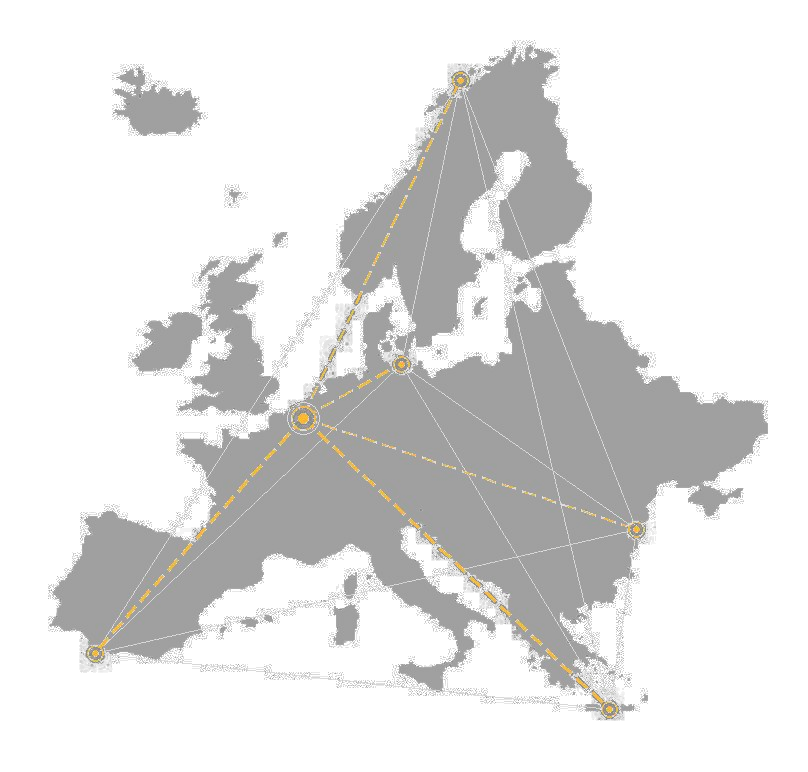
ESDA is an original policy proposal for a new European defence alliance established through an independent treaty — the EDE Treaty (European Defence Ecosystem) — outside EU institutional frameworks. The alliance is open to all European democracies, including the UK and Norway.
The proposal addresses four structural weaknesses in European defence: dependence on US capabilities (including the permanent stationing of approximately 100,000 US troops, which creates a structurally unsustainable dependency), the EU frameworks' lack of decision-making capacity, fragmentation of national forces and procurement — and the absence of a common, standing European response force.
ESDA is not a European army and not an alternative to NATO. It is a shared capability layer added on top of national defence forces, supplementing NATO with capabilities Europe lacks: strategic airlift, aerial refuelling, a common operational picture and intelligence, shared logistics — and a mobile European response force. Funding falls within NATO's 5% framework — not on top of it.
"It is not resources or will that are lacking. It is action — and a plan for a new shared structure."
Europe has the resources, the technology and the populations to defend itself. Yet the continent has for decades ceded strategic responsibility to the United States — not out of necessity, but out of habit and convenience. This is neither fair to Europe itself nor to the United States. An ally that cannot bear its own burden is not an equal partner.
The problem is not inadequate budget frameworks. It is four structural weaknesses that together render Europe incapable of independent action: dependence on key US capabilities (including the permanent stationing of approximately 100,000 US troops, which creates a structurally unsustainable dependency), the EU frameworks' lack of decision-making capacity, fragmentation of national forces and procurement — and the absence of a common, standing European response force. None of these weaknesses can be resolved by higher budgets alone.
ESDA's governance is organised in clear levels — from the national parliaments that ratify the treaty, through the ESDA Council that takes decisions by a two-thirds majority, to the Triumvirate and the day-to-day operations of The Citadel.
The following shows ESDA's funding model under two scenarios: one with broad European participation and one with a core group of 15 countries. In both cases, operating costs are funded within NATO's 5% target.
The decisive political challenge: getting a broad and diverse Europe to act collectively and swiftly, across differing constitutional practices and parliamentary appropriation requirements. The Tier model is the answer.
Surveillance, logistics, cyber defence and capacity building. Decided by two-thirds majority in the ESDA Council — no individual national authorisations required.
Smaller, clearly defined combat operations. Pre-authorised through national framework legislation at ratification — no separate authorisation required for each individual operation.
Large-scale combat operations. Requires national approval where the constitution demands it. Sovereignty is fully preserved.
The two-thirds majority model: A simple majority provides too narrow a mandate — unanimity recreates the EU's paralysis problem. Two-thirds is the precise threshold at which ESDA can act without being paralysed. A member state wishing to block cannot.
ESDA is built incrementally with built-in governance mechanisms. Programmes are adjusted or terminated if they fail to deliver.
Independent mid-term review